




Islam and the West
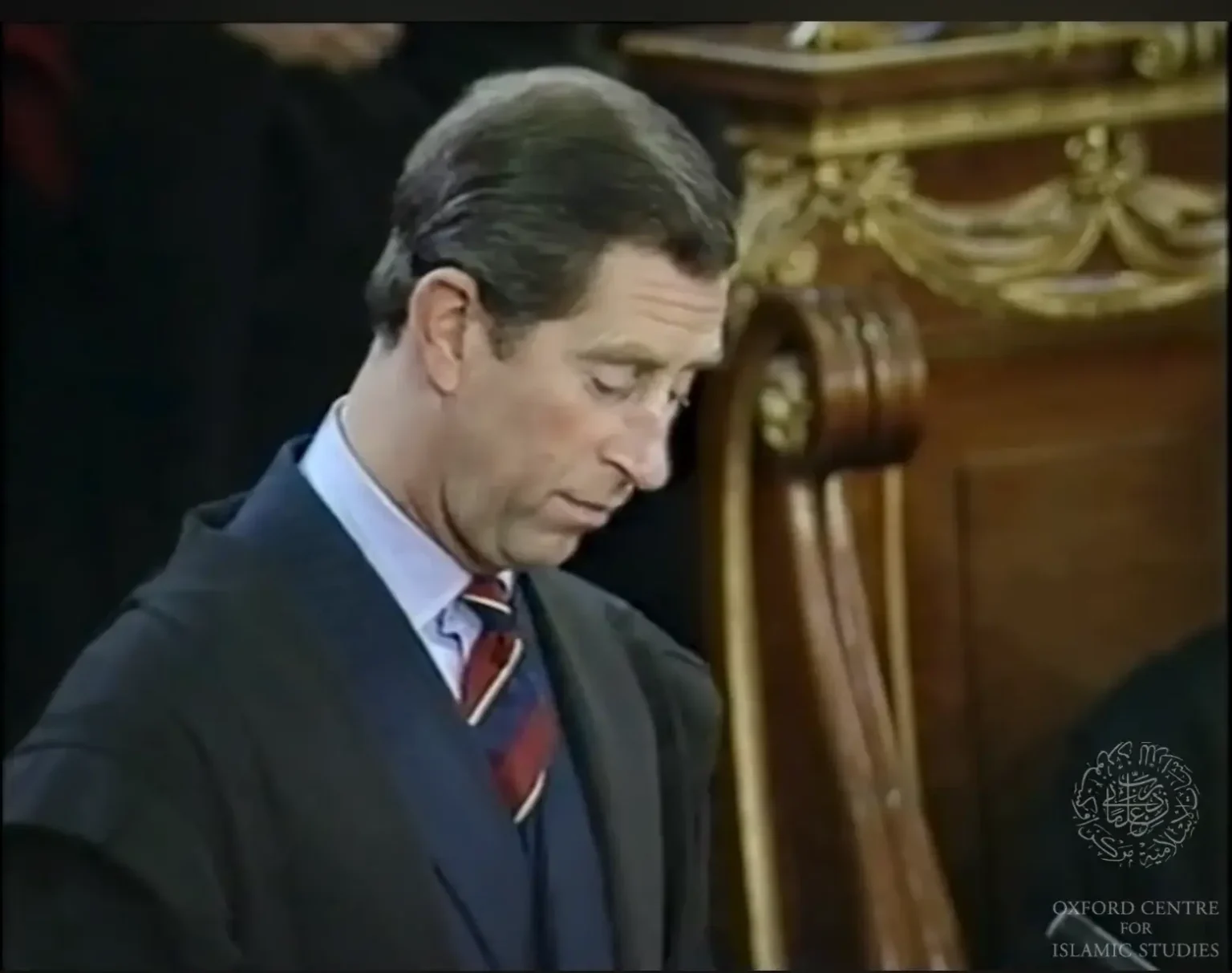
A speech by HRH The Prince of Wales titled ‘Islam and the West’ at the Oxford Centre for Islamic Studies , The Sheldonian Theatre, Oxford
27th October 1993
Ladies and gentlemen, it was suggested to me when I first began to consider the subject of this lecture, that I should take comfort from the Arab proverb, ‘In every head there is some wisdom’. I confess that I have few qualifications as a scholar to justify my presence here, in this theatre, where so many people much more learned than I have preached and generally advanced the sum of human knowledge. I might feel more prepared if I were an offspring of your distinguished University, rather than a product of that ‘Technical College of the Fens’ – though I hope you will bear in mind that a chair of Arabic was established in 17th century Cambridge a full four years before your first chair of Arabic at Oxford.
Unlike many of you, I am not an expert on Islam – though I am delighted, for reasons which I hope will become clear, to be a Patron of the Oxford Centre for Islamic Studies. The Centre has the potential to be an important and exciting vehicle for promoting and improving understanding of the Islamic world in Britain, and one which I hope will earn its place alongside other centres of Islamic study in Oxford, like the Oriental Institute and the Middle East Centre, as an institution of which the University, and scholars more widely, will become justly proud.
Given all the reservations I have about venturing into a complex and controversial field, you may well ask why I am here in this marvellous Wren building talking to you on the subject of Islam and the West. The reason is, ladies and gentlemen, that I believe wholeheartedly that the links between these two worlds matter more today than ever before, because the degree of misunderstanding between the Islamic and Western worlds remains dangerously high, and because the need for the two to live and work together in our increasingly interdependent world has never been greater. At the same time I am only too well aware of the minefields which lie across the path of the inexpert traveller who is bent on exploring this difficult route. Some of what I shall say will undoubtedly provoke disagreement, criticism, misunderstanding and, knowing my luck, probably worse. But perhaps, when all is said and done, it is worth recalling another Arab proverb: ‘What comes from the lips reaches the ears. What comes from the heart reaches the heart.’
The depressing fact is that, despite the advances in technology and mass communication of the second half of the 20th century, despite mass travel, the intermingling of races, the ever-growing reduction – or so we believe – of the mysteries of our world, misunderstandings between Islam and the West continue. Indeed, they may be growing. As far as the West is concerned, this cannot be because of ignorance. There are one billion Muslims worldwide. Many millions of them live in countries of the Commonwealth. Ten million or more of them live in the West, and around one million here in Britain. Our own Islamic community has been growing and flourishing for decades. There are nearly 500 mosques in Britain. Popular interest in Islamic culture in Britain is growing fast. Many of you will recall – and I think some of you took part in – the wonderful Festival of Islam which Her Majesty The Queen opened in 1976. Islam is all around us. And yet distrust, even fear, persist.
In the post-Cold War world of the 1990s, the prospects for peace should be greater than at any time this century. In the Middle East, the remarkable and encouraging events of recent weeks have created new hope for an end to an issue which has divided the world and been so dramatic a source of violence and hatred. But the dangers have not disappeared. In the Muslim world, we are seeing the unique way of life of the Marsh Arabs of Southern Iraq, thousands of years old, being systematically devastated and destroyed. I confess that for a whole year I have wanted to find a suitable opportunity to express my despair and outrage at the unmentionable horrors being perpetrated in Southern Iraq. To me, the supreme and tragic irony of what has been happening to the Shia population of Iraq – especially in the ancient city and holy shrine of Kerbala – is that after the western allies took immense care to avoid bombing such holy places (and I remember begging General Schwarzkopf when I met him in Riyadh in December 1990, before the actual war began to liberate Kuwait, to do his best to protect such shrines during any conflict), it was Saddam Hussein himself, and his terrifying regime, who caused the destruction of some of Islam’s holiest sites.
And now we have to witness the deliberate draining of the marshes and the near total destruction of a unique habitat, together with an entire population that has depended on it since the dawn of human civilisation. The international community has been told the draining of the marshes is for agricultural purposes. How many more obscene lies do we have to be told before action is actually taken? Even at the eleventh hour it is still not too late to prevent a total cataclysm.I pray that this might at least be a cause in which Islam and the West could join forces for the sake of our common humanity.
I have highlighted this particular example because it is so avoidable. Elsewhere, the violence and hatred are more intractable and deep-seated, as we go on seeing every day to our horror in the wretched suffering of peoples across the world – in the former Yugoslavia, in Somalia, Angola, Sudan, in so many of the former Soviet Republics. In Yugoslavia the terrible sufferings of the Bosnian Muslims, alongside that of other communities in that cruel war, help keep alive many of the fears and prejudices which our two worlds retain of each other. Conflict, of course, comes about because of the misuse of power and the clash of ideals, not to mention the inflammatory activities of unscrupulous and bigoted leaders. But it also arises, tragically, from an inability to understand, and from the powerful emotioins which, out of misunderstanding, lead to distrust and fear. Ladies and gentlemen, we must not slide into a new era of danger and division because governments and peoples, communities and religions, cannot live together in peace in a shrinking world.
It is odd, in many ways, that misunderstandings between Islam and the West should persist. For that which binds our two worlds together is so much more powerful than that which divides us. Muslims, Christians – and Jews – are all ‘peoples of the Book’. Islam and Christianity share a common monotheistic vision: a belief in one divine God, in the transience of our earthly life, in our accountability for our actions, and in the assurance of life to come. We share many key values in common: respect for knowledge, for justice, compassion towards the poor and underprivileged, the importance of family life, respect for parents. ‘Honour thy father and thy mother’ is a Quranic precept too. Our history has been closely bound up together.
There, however, is one root of the problem. For much of that history has been one of conflict; 14 centuries too often marked by mutual hostility. That has given rise to an enduring tradition of fear and distrust, because our two worlds have so often seen that past in contradictory ways. To Western schoolchildren, the 200 years of the Crusades are traditionally seen as a series of heroic, chivalrous exploits in which the kings, knights, princes – and children – of Europe tried to wrest Jerusalem from the wicked Muslim infidel. To Muslims, the Crusades were an episode of great cruelty and terrible plunder, of Western infidel soldiers of fortune and horrific atrocities, perhaps exemplified best by the massacres committed by the Crusaders when, in 1099, they took back Jerusalem, the third holiest city in Islam. For us in the West, 1492 speaks of human endeavour and new horizons, of Columbus and the discovery of the Americas. To Muslims, 1492 is a year of tragedy – the year Granada fell to Ferdinand and Isabella, signifying the end of eight centureis of Muslim civilisation in Europe.
The point, I think, is not that one or other picture is more true, or has a monopoly of truth. It is that misunderstandings arise when we fail to appreciate how others look at the world, its history, and our respective roles in it.
The corollary of how we in the West see our history has so often been to regard Islam as a threat – in medieval times as a military conqueror, and in more modern times as a source of intolerance, extremism and terrorism. One can understand how the taking of Constantinople, when it fell to Sultan Mehmet in 1453, and the close-run defeats of the Turks outside Vienna in 1529 and 1683, should have sent shivers of fear through Europe’s rulers. The history of the Balkans under Ottoman rule provided examples of cruelty which sank deep into Western feelings. But the threat has not been one way. With Napoleon’s invasion of Egypt in 1798, followed by the invasions and conquests of the 19th century, the pendulum swung, and almost all the Arab world became occupied by the Western powers. With the fall of the Ottoman Empire, Europe’s triumph over Islam seemed complete.
Those days of conquest are over. But even now our common attitude to Islam suffers because the way we understand it has been hijacked by the extreme and the superficial. To many of us in the West, Islam is seen in terms of the tragic civil war in Lebanon, the killings and bombings perpetrated by extremist groups in the Middle East, and by what is commonly referred to as ‘Islamic fundamentalism’. Our judgement of Islam has been grossly distorted by taking the extremes to be the norm. That, ladies and gentlemen, is a serious mistake. It is like judging the quality of life in Britain by the existence of murder and rape, child abuse and drug addiction. The extremes exist, and they must be dealt with. But when used as a basis to judge a society, they lead to distortion and unfairness.
For example, people in this country frequently argue that Sharia law of the Islamic world is cruel, barbaric and unjust. Our newspapers, above all, love to peddle those unthinking prejudices. The truth is, of course, different and always more complex. My own understanding is that extremes are rarely practised. The guiding principle and spirit of Islamic law, taken straight from the Qur’an, should be those of equity and compassion. We need to study its actual application before we make judgements. We must distinguish between systems of justice administered with integrity, and systems of justice as we may see them practised which have been deformed for political reasons into something no longer Islamic. We must bear in mind the sharp debate taking place in the Islamic world itself about the extent of the universality or timelessness of Sharia law, and the degree to which the application of that law is continually changing and evolving.
We should also distinguish Islam from the customs of some Islamic states. Another obvious Western prejudice is to judge the position of women in Islamic society by the extreme cases. Yet Islam is not a monolith and the picture is not simple. Remember, if you will, that Islamic countries like Turkey, Egypt and Syria gave women the vote as early as Europe did its women – and much earlier than in Switzerland! In those countries women have long enjoyed equal pay, and the opportunity to play a full working role in their societies. The rights of Muslim women to property and inheritance, to some protection if divorced, and to the conducting of business, were rights prescribed by the Qur’an 1,400 years ago, even if they were not everywhere translated into practice. In Britain at least, some of these rights were novel even to my grandmother’s generation! Benazir Bhutto and Begum Khaleda Zia became prime ministers in their own traditional societies when Britain had for the first time ever in its history elected a female prime minister. That, I think, does not necessarily smack of a mediaeval society.
Women are not automatically second-class citizens because they live in Islamic countries. We cannot judge the position of women in Islam aright if we take the most conservative Islamic states as representative of the whole. For example, the veiling of women is not at all universal across the Islamic world. Indeed, I was intrigued to learn that the custom of wearing the veil owed much to Byzantine and Sassanian traditions, nothing to the Prophet of Islam. Some Muslim women never adopted the veil, others have discarded it, others – particularly the younger generation – have more recently chosen to wear the veil or the headscarf as a personal statement of their Muslim identity. But we should not confuse the modesty of dress prescribed by the Qur’an for men as well as women with the outward forms of secular custom or social status which have their origins elsewhere.
We in the West need also to understand the Islamic world’s view of us. There is nothing to be gained, and much harm to be done, by refusing to comprehend the extent to which many people in the Islamic world genuinely fear our own Western materialism and mass culture as a deadly challenge to their Islamic culture and way of life. Some of us may think the material trappings of Western society which we have exported to the Islamic world – television, fast-food and the electronic gadgets of our everyday lives – are a modernising, self-evidently good, influence. But we fall into the trap of dreadful arrogance if we confuse ‘modernity’ in other countries with their becoming more like us. The fact is that our form of materialism can be offensive to devout Muslims – and I do not just mean the extremists among them. We must understand that reaction, just as the West’s attitude to some of the more rigorous aspects of Islamic life, needs to be understood in the Islamic world.
This, I believe, would help us understand what we have commonly come to see as the threat of Islamic fundamentalism. We need to be careful of that emotive label, ‘fundamentalism’, and distinguish, as Muslims do, between revivalists, who choose to take the practice of their religion most devoutly, and fanatics or extremists who use this devotion for their political ends. Among the many religious, social and political causes of what we might more accurately call the Islamic revival is a powerful feeling of disenchantment, of the realisation that Western technology and material things are insufficient, and that a deeper meaning to life lies elsewhere in the essence of Islamic belief.
At the same time, we must not be tempted to believe that extremism is in some way the hallmark and essence of the Muslim. Extremism is no more the monopoly of Islam than it is the monopoly of other religions, including Christianity. The vast majority of Muslims, though personally pious, are moderate in their politics. Theirs is the ‘religion of the middle way’. The Prophet himself always disliked and feared extremism. Perhaps the fear of Islamic revivalism which coloured the 1980s is now beginning to give way in the West to an understanding of the genuine spiritual forces behind this groundswell. But if we are to understand this important movement, we must learn to distinguish clearly between what the vast majority of Muslims believe and the terrible violence of a small minority among them – like the men in Cairo yesterday – which civilised people everywhere must condemn.
Chancellor, ladies and gentlemen, if there is much misunderstanding in the West about the nature of Islam, there is also much ignorance about the debt our own culture and civilisation owe to the Islamic world. It is a failure which stems, I think, from the straitjacket of history which we have inherited. The medieval Islamic world, from Central Asia to the shores of the Atlantic, was a world where scholars and men of learning flourished. But because we have tended to see Islam as the enemy of the West, as an alien culture, society and system of belief, we have tended to ignore or erase its great relevance to our own history.
For example, we have underestimated the importance of 800 years of Islamic society and culture in Spain between the 8th and 15th centuries. The contribution of Muslim Spain to the preservation of classical learning during the Dark Ages, and to the first flowerings of the Renaissance, has long been recognised. But Islamic Spain was much more than a mere larder where Hellenistic knowledge was kept for later consumption by the emerging modern Western world. Not only did Muslim Spain gather and preserve the intellectual content of ancient Greek and Roman civilisation, it also interpreted and expanded upon that civilisation, and made a vital contribution of its own in so many fields of human endeavour – in science, astronomy, mathematics, algebra (itself an Arabic word), law, history, medicine, pharmacology, optics, agriculture, architecture, theology, music. Averroes and Avenzoor, like their counterparts Avicenna and Rhazes in the East, contributed to the study and practice of medicine in ways from which Europe benefited for centuries afterwards.
Islam nurtured and preserved the quest for learning. In the words of the tradition, ‘the ink of the scholar is more sacred than the blood of the martyr’. Cordoba in the 10th century was by far the most civilised city of Europe. We know of lending libraries in Spain at the time King Alfred was making terrible blunders with the culinary arts in this country. It is said that the 400,000 volumes in its ruler’s library amounted to more books than all the libraries of the rest of Europe put together. That was made possible because the Muslim world acquired from China the skill of making paper more than 400 years before the rest of non-Muslim Europe. Many of the traits on which modern Europe prides itself came to it from Muslim Spain. Diplomacy, free trade, open borders, the techniques of academic research, of anthropology, etiquette, fashion, various types of medicine, hospitals, all came from this great city of cities.
Medieval Islam was a religion of remarkable tolerance for its time, allowing Jews and Christians the right to practise their inherited beliefs, and setting an example which was not, unfortunately, copied for many centuries in the West. The surprise, ladies and gentlemen, is the extent to which Islam has been a part of Europe for so long, first in Spain, then in the Balkans, and the extent to which it has contributed so much towards the civilisation which we all too often think of, wrongly, as entirely Western. Islam is part of our past and our present, in all fields of human endeavour. It has helped to create modern Europe. It is part of our own inheritance, not a thing apart.
More than this, Islam can teach us today a way of understanding and living in the world which Christianity itself is the poorer for having lost. At the heart of Islam is its preservation of an integral view of the Universe. Islam – like Buddhism and Hinduism – refuses to separate man and nature, religion and science, mind and matter, and has preserved a metaphysical and unified view of ourselves and the world aruond us. At the core of Christianity there still lies an integral view of the sanctity of the world, and a clear sense of the trusteeship and responsibility given to us for our natural surroundings. In the words of that marvellous 17th century poet and hymn writer George Herbert:
‘A man that looks on glass,
On it may stay his eye;
Or if he pleaseth, through it pass,
And then the heaven espy.’
But the West gradually lost this integrated vision of the world with Copernicus and Descartes and the coming of the scientific revolution. A comprehensive philosophy of nature is no longer part of our everyday beliefs. I cannot help feeling that, if we could now only rediscover that earlier, all-embracing approach to the world around us, to see and understand its deeper meaning, we could begin to get away from the increasing tendency in the West to live on the surface of our surroundings, where we study our world in order to manipulate and dominate it, turning harmony and beauty into disequilibrium and chaos.
It is a sad fact, I believe, that in so many ways the external world we have created in the last few hundred years has come to reflect our own divided and confused inner state. Western civilisation has become increasingly acquisitive and exploitative in defiance of our environmental responsibilities. This crucial sense of oneness and trusteeship of the vital sacramental and spiritual character of the world about us is surely something important we can re-learn from Islam. I am quite sure some will instantly accuse me, as they usually do, of living in the past, of refusing to come to terms with reality and modern life. On the contrary, ladies and gentlemen, what I am appealing for is a wider, deeper, more careful understanding of our world; for a metaphysical as well as a material dimension to our lives, in order to recover the balance we have abandoned, the absence of which, I believe, will prove disastrous in the long term. If the ways of thought found in Islam and other religions can help us in that search, then there are things for us to learn from this system of belief which I suggest we ignore at our peril.
Ladies and gentlemen, we live today in one world, forged by instant communications, by television, by the exchange of information on a scale undreamed of by our grandparents. The world economy functions as an inter-dependent entity. Problems of society, the quality of life and the environment, are global in their causes and effects, and none of us any longer has the luxury of being able to solve them on our own. The Islamic and Western worlds share problems common to us all: how we adapt to change in our societies, how we help young people who feel alienated from their parents or their society’s values, how we deal with Aids, drugs, and the disintegration of the family. Of course, these problems vary in nature and intensity between societies. The problems of our own inner cities are not identical to those of Cairo or Damascus. But the similarity of human experience is considerable. The international trade in hard drugs is one example; the damage we are collectively doing to our environment is another.
We have to solve these threats to our communities and lives together. Simply getting to know each other can achieve wonders. I remember vividly, for instance, taking a group of Muslims and non-Muslims some years ago to see the work of the Marylebone Health Centre in London, of which I am Patron. The enthusiasm and common determination that shared experience generated was immensely heart-warming. Ladies and gentlemen, somehow we have to learn to understand each other, and to educate our children – a new generation, whose attitudes and cultural outlook may be different from ours – so that they understand too. We have to show trust, mutual respect and tolerance, if we are to find the common ground between us and work together to find solutions. The community enterprise approach of my own Trust, and the very successful Volunteers Scheme it has run for some years, show how much can be achieved by a common effort which spans classes, cultures and religions.
The Islamic and Western world can no longer afford to stand apart from a common effort to solve their common problems. One excellent example of our two cultures working together in common cause is the way in which the Kingdom of Saudi Arabia is working with Oxford University to set up a research centre into schizophrenia for an organisation called SANE, of which I am Patron.
Nor can we afford to revive the territorial and political confrontations of the past. We have to share experiences, to explain ourselves to each other, to understand and tolerate – and I know how difficult these things are – and to build on those positive principles which our two cultures have in common. That trade has to be two-way. Each of us needs to understand the importance of conciliation, of reflection – TADABBUR is the word, I believe – to open our minds and unlock our hearts to each other. I am utterly convinced that the Islamic and the Western worlds have much to learn from each other. Just as the oil engineer in the Gulf may be European, so the heart transplant surgeon in Britain may be Egyptian.
If this need for tolerance and exchange is true internationally, it applies with special force within Britain itself. Britain is a multi-racial and multi-cultural society. I have already mentioned the size of our own Muslim communities who live throughout Britain, both in large towns like Bradford and in tiny communities in places as remote as Stornaway in Western Scotland. These people, ladies and gentlemen, are an asset to Britain. They contribute to all parts of our economy – to industry, the public services, the professions and the private sector. We find them as teachers, as doctors, as engineers and as scientists. They contribute to our economic well-being as a country, and add to the cultural richness of our nation. Of course, tolerance and understanding must be two-way. For those who are not Muslim, that may mean respect for the daily practice of the Islamic faith and a decent care to avoid actions which are likely to cause deep offence. For the Muslims in our society, there is the need to respect the history, culture and way of life of our country, and to balance their vital liberty to be themselves with an appreciation of the importance of integration in our society. Where there are failings of understanding and tolerance, we have a need, on our own doorstep, for greater reconciliation among our own citizens. I hope we shall all learn to demonstrate this as understanding between these communities grows.
I can only admire, and applaud, those men and women of so many denominations who work so tirelessly, in London, South Wales, the Midlands and elsewhere, to promote good community relations. The Centre for the Study of Islam and Christian-Muslim Relations in Birmingham is one especially notable and successful example. We should be grateful, I believe, for the dedication and example of all those who have devoted themselves to the cause of promoting understanding.
Ladies and gentlemen, if, in the last half hour, your eyes have wandered up to the marvellous allegory of Truth descending on the arts and sciences in Sir Robert Streeter’s ceiling above you, I am sure you will have noticed Ignorance being violently banished from the arena – just there in front of the organ casing. I feel some sympathy for Ignorance, and hope I may be permitted to vacate this theatre in a somewhat better condition…
Before I go, I cannot put to you strongly enough the importance of the two issues which I have tried to touch on so imperfectly this morning. These two worlds, the Islamic and the Western, are at something of a crossroads in their relations. We must not let them stand apart. I do not accept the argument that they are on course to clash in a new era of antagonism. I am utterly convinced that our two worlds have much to offer each other. We have much to do together. I am delighted that the dialogue has begun, both in Britain and elsewhere. But we shall need to work harder to understand each other, to drain out any poison between us, and to lay the ghost of suspicion and fear. The further down that road we can travel, the better the world that we shall create for our children and for future generations.
A SENSE OF THE SACRED:
BUILDING BRIDGES BETWEEN ISLAM AND THE WEST
H.R.H. Charles, Prince of Wales
H.R.H. Prince Charles of England delivered the following speech on December 13, 1996, at the fiftieth anniversary celebration of the Wilton Park, a respected institute in England for the study of international issues.
* * *
I hesitated a long time before suggesting that it might be worth trying to use this occasion to hold a seminar on a Sense of the Sacred and its relevance to the problem of understanding between the Islamic and Western worlds… But I am encouraged by the fact that, whenever I have summoned up my courage to speak about this subject… it seems always to have struck an extraordinary chord, and captured a remarkable degree of attention. My belief is that in each one of us there is a distant echo of this sense of the sacred, but that the majority of us are terrified to admit its existence for fear of ridicule and abuse. This fear of ridicule, even to the extent of mentioning the name of God, is a classic indication of the loss of meaning in so-called Western civilization.
I start from the belief that Islamic civilization at its best, like many of the religions of the East – Judaism, Hinduism, Jainism and Buddhism – has an important message for the West in the way it has retained a more integrated and integral view of the sanctity of the world around us. I feel that we in the West could be helped to rediscover those roots of our own understanding by an appreciation of the Islamic tradition’s deep respect for the timeless traditions of the natural order. I believe that process could help in the task of bringing our two faiths closer together. It could also help us in the West to rethink, and for the better, our practical stewardship of man and his environment — in fields like health-care, the natural environment and agriculture, as well as in architecture and urban planning. I want very briefly to explain why this might be so.
Modern materialism in my humble opinion is unbalanced and increasingly damaging in its long-term consequences. Yet nearly all the great religions of the world have held an integral view of the sanctity of the world. The Christian message with, for example, its deeply mystical and symbolic doctrine of the Incarnation, has been traditionally a message of the unity of the worlds of spirit and matter, and of God’s manifestation in this world and humankind. But during the last three centuries, in the Western world at least, a dangerous division has come into being in the way we perceive the world around us. Science has tried to assume a monopoly – even a tyranny – over our understanding. Religion and science have become separated, with the result, as William Wordsworth said, “Little we see in nature that is ours”. Science has attempted to take over the natural world from God, with the result that it has fragmented the cosmos and relegated the sacred to a separate, and secondary, compartment of our understanding, divorced from the practical day to day existence.
We are only now beginning to gauge the disastrous results of this outlook. We in the Western world seem to have lost a sense of the wholeness of our environment, and of our immense and inalienable responsibility to the whole of creation. This has led to an increasing failure to appreciate or understand tradition, and the wisdom of our forebears accumulated over the centuries….
In my view, a more holistic approach is needed in our contemporary world. Science has done the inestimable service of showing us a world much more complex than we ever imagined. But in its modern, materialist, one-dimensional form, it cannot explain everything. God is not merely the ultimate Newtonian mathematician or the mechanistic clockmaker. Francis Bacon said that God will not produce miracles to convince those who cannot see the miracle of a growing blade of grass and falling rain. As science and technology have become increasingly separated from ethical, moral and sacred considerations, so have the implications of such a separation become more somber and horrifying— as we see, for example, in genetic manipulation…
I believe there is a growing sense of the danger of these materialist presumptions in our increasingly alienated and dissatisfied world. Some may say that the tide is, perhaps, beginning to turn, but I fear there are large herds of conventional sacred cows blocking the path. Some scientists are slowly coming to realize the awe-inspiring complexity and mystery of the universe. But there remains a need to rediscover the bridge between what the great faiths of the world have recognized as our inner and our outer worlds, our physical and our spiritual nature. That bridge is the expression of our humanity. It fulfills this role through the medium of traditional knowledge and art, which have civilized mankind and without which civilization could not long be maintained. After centuries of neglect and cynicism the transcendental wisdom of the great religious traditions, including the Judaeo-Christian and the Islamic, and the metaphysics of the Platonic tradition which was such an important inspiration for Western philosophical and spiritual ideas, is finally being rediscovered.
I have always felt that tradition is not a man-made element in our lives, but a God-given intuition of natural rhythms, of the fundamental harmony which emerges from the union of those paradoxical opposites which exist in every aspect of nature. Tradition reflects the timeless order of the cosmos, and anchors us into an awareness of the great mysteries of the universe so that, as Blake put it, we can see the whole universe in an atom and eternity in a moment. That is why I believe Man is so much more than just a biological phenomenon resting on what we now seem to define as “the bottom line” of the great balance sheet of life according to which art and culture are seen increasingly as optional extras in life. The view is so contrary, for example, to the outlook of the Muslim craftsman or artist, who was never concerned with display for its own sake, nor with progressing ever forward in his own ingenuity, but was content to submit a man’s craft to God. That outlook reflects, I believe, the memorable passage in the Qur’an, “withersoever you turn there is the face of God and God is all embracing, all knowing”. While appreciating that this essential innocence has been destroyed, and destroyed everywhere, I nevertheless believe that the survival of civilized values, as we have inherited them from our ancestors, depends on the corresponding survival in our hearts of that profound sense of the sacred and the spiritual.
Traditional religions, with their integral view of the universe, can help us in an important way to rediscover the importance of the integration of the secular and the sacred—as I tried to argue in my speech in Oxford in 1993 on Islam and the West. The danger of ignoring this essential aspect of our existence is not just spiritual or intellectual. It also lies at the heart of that great divide between the Islamic and Western worlds over the place of materialism in our lives. In those instances where Islam chooses to reject Western materialism, this is not, in my view, only a political affectation or the result of envy or a sense of inferiority. Quite the opposite. And the danger that the gulf between the worlds of Islam and the other major Eastern religions on the one hand, and the West on the other, will grow ever wider and more unbridgeable is real, unless we can explore together practical ways of integrating the sacred and the secular in both our cultures in order to provide a true inspiration for the next century.
This rediscovery of an integrated view of the sacred could also help us in areas of important practical activity. In Medicine, whatever some scientists might say, the rupture between religion and science, between the material world and a sense of the sacred, has too often led to a bunkered approach to healthcare, and to a failure to understand the wholeness and manifest mystery of the healing process. Hospitals need to be conceived and, above all, designed to reflect the wholeness of healing if they are to help the process of recovery in a more complete way…
Our Environment has suffered beyond our worst nightmares, in part because of a one-sided approach to economic development which, until very recently, failed to take account of the inter-relatedness of creation. Little thought was given to the importance of finding that sustainable balance which worked within the grain of nature and understood the vital necessity of setting and respecting limits. This, for example, is why protection of our environment is a relatively recent concern; and why organic and sustainable farming are so important if we are to use the land in a way which will safeguard its ability to nourish future generations.
A third area in which this separation of the material and spiritual has had dramatic consequences is Architecture. I believe this separation lies at the heart of the failure of so much modern architecture to understand the essential spiritual quality and the traditional principles that reflect a cosmic harmony, from which come buildings with which people feel comfortable and in which they want to live. That is why I started my own Institute of Architecture. Titus Buckhardt wrote: “It is the nature of art to rejoice the soul, but not every art possesses a spiritual dimension”. We see this spirituality in traditional Christian architecture. It also infuses the intricate geometric and arabesque patterns of Islamic art and architecture, which are ultimately a manifestation of Divine Unity, which in turn is the central message of the Qur’an. The Prophet Mohammed himself is believed to have said “God is beautiful and He loves beauty.” Look at urban planning. The great historian, Ibn Khaldun, understood that the intimate relationship between city life and spiritual tranquillity was an essential basis for civilization. Can we ever again return to such harmony in our cities? As civilizations decay, so do the crafts, as Ibn Khaldun again wrote.
All these principles come down in the end to a battle for preserving sacred values. It is a battle to restore an understanding of the spiritual integrity of our lives, and for reintegrating what the modern world has fragmented. Islamic culture in its traditional form has striven to preserve this integrated spiritual view of the world in a way we have not seen fit to do in recent generations in the West. There is much we can share with that Islamic world view in this respect, and much in that world view which can help us to understand the shared and timeless elements in our two faiths. In that common endeavor both our modern societies, Islamic and Western, can learn afresh the traditional views of life common to our religions, as well as the sacred responsibilities we have for the care and stewardship of the world around us.
In my Oxford speech in 1993, I argued for a much greater effort to be made to encourage understanding between the Islamic and Western worlds. My firm belief in the importance of that process has not changed. The harm that will be done to both cultures if ignorance and prejudice persist – or grow – will be incalculable. There are many ways in which this understanding and appreciation can be built. But even if we begin with a simple understanding of the sacred, which permeates every aspect of our world, there is the potential for establishing new and valuable links between Islamic civilization and the West. Perhaps, for instance, we could begin by having more Muslim teachers in British schools, or by encouraging exchanges of teachers. Everywhere in the world people are seemingly wanting to learn English. But in the West, in turn, we need to be taught by Islamic teachers how to learn once again with out hearts, as well as our heads. The approaching millennium may be the ideal catalyst for helping to explore and stimulate these links, and I hope we shall not ignore the opportunity this gives us to rediscover the spiritual underpinning of our existence. For myself, I am convinced that we cannot afford, for the health and sustainability of a civilized existence, any longer to ignore these timeless features of our world. A sense of the sacred can, I believe, help provide the basis for developing a new relationship of understanding which can only enhance the relations between our two faiths —and indeed between all faiths— for the benefit of our children and future generations.
Unity in Faith
Please see HRH The Prince of Wales speech delivered at Al-Azhar on 3/21/2006. I have just received as a checked against delivery version
from Cairo. For those who would find it useful, an Arabic version will be up on the website later today. http://www.fco.gov.uk
I
Your Excellencies, Ladies and Gentlemen, I have been enormously touched that you should have considered inviting me to speak at this
most venerable and ancient place of worship and learning. You have done me the greatest honour through your invitation, and indeed
through conferring this much treasured honorary doctorate on me, and I count it a very special privilege to visit the University of
Al Azhar and, indeed, to return to Egypt – a country for which I have a particular affection and which, for many, has a sacred significance
as the place of refuge for the child Jesus.
I would like to begin by paying tribute to the man who first encouraged me to accept the invitation to speak here, a dear friend
and graduate of this great university, Shaikh Zaki Badawi. His sudden death in January was a profound shock and an immense sadness
to many of us across the world. He was a man of real wisdom and learning. With the humility of a true scholar, he made his great
knowledge accessible to others – and did so with an irresistible sense of humour. I am so pleased and proud that his widow Lady
Badawi is with us for this occasion.
I do not claim to be a scholar, other than having studied history at the University of Cambridge – not quite as old as this one, but I do
have a great interest in exploring the Abrahamic tradition into which I was born. This tradition has shaped me and made me who I am.
Today I stand before you as one belonging to the family of faiths connected by that tradition.
II
The roots of the faith that we share in the One God, the God of Abraham, give us enduring values. We need the courage to speak of
them and affirm them again and again to a world troubled by change and dissension. That is the message which, above all, I wish to
leave you with today. First, and highest among those values of our common inheritance, and born of our love of God, must always come
respect for each other, and for His creation. Our respect for all God’s creatures and for the environment is the expression of our
respect for the Creator whose inspiration is the entire manifest world.
Secondly, and following from this, our beliefs and values call out for peace and not conflict. We may have a human weakness to
criticise and to compete with each other. But what we have in common, as people of faith, calls us beyond this towards mutual
respect and understanding.
Thirdly, the great Abrahamic traditions speak of a faith which rests in the heart beyond the limitations of our intellectual knowledge and
judgement. Wherever we are placed in our human society, whatever the advantages or disadvantages we have in ability or education, we
perceive the truths of our faith with the `eye of the heart’. The Prophet Moses reminded us that the heart is the seat of faith: “Thou
shalt love the Lord thy God with all thine heart” . I believe that the great faiths speak through their sacred texts to the heart, and
that faith itself is heart-felt.
But while I cherish the connections within the history of our different Abrahamic Faiths, I do not want you to imagine for one
moment that I think that they are one and the same. There are differences, and we should celebrate them. But in the things that
matter most, we have a common root. In my view, God’s purpose should never be in doubt: it is to bind us closer together! Unity through
diversity… Indeed, it has always moved me that the Holy Koran has a verse: “O Mankind! We created you from a single pair of a male and
a female, and made you into nations and tribes, that ye may know each other (not that ye may despise each other).”
III
I first voiced my thoughts publicly on relations between Islam and
the West in 1993, in a speech at another great university, Oxford.
Something I said then has troubled me ever since. I said:
…despite the advances in technology and mass communication in the
second half of the twentieth century, despite mass travel and the
intermingling of races…misunderstandings between Islam and the West
continue. Indeed they may be growing.
Tragically, the intervening twelve years have confirmed my fears and,
for so many, those years have been profoundly bleak. My heart is
heavy from witnessing the never-ending death and destruction – the
kind of death and destruction I understand only too well, having
experienced the loss of my beloved Great Uncle, Lord Mountbatten, at
the hands of terrorist bombers in 1979. Images of communities torn
apart by religious conflict are deeply harrowing – from Bosnia to
Baghdad, from Chechnya to Palestine – evidence of just how far
misunderstandings have continued and escalated. Violence, so often
justified in the name of religion, effects a terrible hardening of
hearts. What good can possibly come of all of this?
In that same speech, I talked about the history of Europe and the
Islamic world – how they were inextricably entwined, and how, through
the centuries, the giving and taking on both sides had contributed so
greatly to what we have become today. History shows what giant leaps
of creativity in knowledge – in science, literature and the arts –
have occurred when the members of the Abrahamic family have worked
together. Can we not draw inspiration from the great explosion of
knowledge and understanding which took place under the Abbassids
between the ninth and thirteenth centuries, when their capital
Baghdad was a world centre of learning; or from Islamic Spain between
the tenth and the fourteenth centuries, when in cities such as
Cordoba and Toledo, the work of Christian, Muslim and Jewish scholars
led to the flowering of the Renaissance? We need to remember that we
in the West are in debt to the scholars of Islam, for it was thanks
to them that during the Dark Ages in Europe the treasures of
classical learning were kept alive.
But in that same speech I also spoke of how, sadly, despite this
fertile flow of ideas, many on both sides had still been left with
uncompromising prejudices towards each other’s cultures. This
lingering mutual distrust persists, and with dreadful results. I
think of the experience of Muslims living in Europe who are subject
to varied and continuous expressions of Islamophobia by fellow-
Europeans. I think of Christians living within some Muslim nations,
who find themselves fettered by harsh and degrading restrictions, or
subject to abuse by some of their fellow-citizens. And I think of
dreadful acts of terrorism and violence across the world, carried out
in the distorted name of faith.
I believe with all my heart that responsible men and women must work
to restore mutual respect between faiths, and that we should do all
we can to overcome the distrust that poisons so many people’s lives.
This, of course, is made infinitely more difficult by the stereotypes
and absurdities propagated by certain sections of the Media. In my
own very modest way, through the work of my Prince’s Trust, my
Foundation for the Built Environment and my School of Traditional
Arts, I have sought to find ways to integrate communities and to
celebrate the virtues of Islamic cultures in the United Kingdom. As
these programmes develop across other countries, I hope that they may
serve as a model for communities elsewhere. Even from small projects
and examples the foundations of mutual respect, consideration and
courtesy can be rebuilt, sometimes through the physical design of
people’s surroundings – surroundings which can help to enhance our
shared humanity rather than treat us as technological adjuncts to the
increasingly mechanistic world around us.
IV
The legacy of misunderstanding and conflict between religions has had
a central role in the terrible history of war and violence. And none
more so, of course, than the truly apocalyptic cruelty and
destruction caused by the two unholy, secular “religions” of
Communism and Fascism.
Over the centuries, as societies have evolved, we can often see two
distinct reactions to this ruinous legacy. Some hold ever more
tightly to their religion, as a source of stability in their lives –
and, as conflicts rage, they identify other traditions only as
threats. Others become disenchanted with religion altogether; with
the whole concept of metaphysics and a dimension beyond ourselves.
They abandon any faith in God, and see religion itself
as “backward,” “primitive” and “wrong”. This disenchantment and
indifference poses a danger for our inheritance of faith, universal
values and a living tradition. Coupled with an obsession with
materialism and trivia, it is a threat across the world, not least to
our own traditional Christian culture.
In Europe, it was partly in reaction to the apparently ceaseless wars
between different Christian denominations that many sincere people
came to think that if we could only create truly secular societies in
which the bigotry, violence and pedantry that people associated with
religion would disappear, the underlying sources of conflict would be
removed, and we would all get on better. They hoped that if, in the
place of institutionalized religion, the material wellbeing and
security of the people could be enhanced and protected through the
discoveries of science, then the march to harmony, progress and human
happiness would continue unopposed.
Inevitably, it has not turned out to be quite so easy. As we are
finding, scientific knowledge, which has brought us all so much that
we value and are privileged to take for granted, is not the same as
Wisdom. For it is Wisdom alone that can reveal to us those universal
and eternal truths that lie at the heart of all the great
traditions. In many people’s lives today these truths, which
provided our forefathers with a secure framework for their existence
and with a clear set of ethical values, have become obscured, have
disappeared entirely from their lives. This is not a phenomenon
peculiar to the West. We see it in each strand of the Abrahamic
faiths.
The implications of this loss run deep. For I believe that
moderation comes from the Wisdom passed down to us through
tradition. Extremism exploits our loss of respect for tradition.
Loss of religious certainty is pushing many to take refuge in new
absolutes which, like any primitive belief, tolerate no doubt or
reservation, but lead to various forms of extremism.
We need to recover the depth, the subtlety, the generosity of
imagination, the respect for Wisdom that so marked Islam in its great
ages. Islam called Jews and Christians the peoples of the book,
because they, like Muslims are a part of a religion of sacred texts:
the Koran, the Hebrew Bible, the New Testament. And what was so
distinctive of the great ages of faith was that they understood that,
as well as sacred texts, there is the art of interpretation of sacred
texts – and this is a difficult and subtle art that gave rise in
Islam to great principles of interpretation and great schools of
jurisprudence.
Between the text and the meaning of the text – between the meaning of
God’s word for all time and its meaning for this time – falls the act
of interpretation. It was Islam’s greatness to understand this in
its full depth and challenge. And this is what you, at this great
and historic institution, can give not only to Islam, but, by
example, to all the other children of Abraham.
Today, too often, there seems to be a tendency to read texts as if
they needed no interpretation, as if we could read their meaning on
the surface. That does violence to the Divine word, and violence to
the word eventually leads to violence to the person, and to the
world.
When all we can hear in sacred texts is simple certainties, when all
we can see in God’s multicoloured world is black and white, we begin
to divide humanity into simple oppositions: the good and the evil;
the pious and the profane; us and the enemy. And this then leads to
hatred and violence. For it is then that we lose the single most
important principle that unites the Abrahamic faiths: in
Judaism, “Love your neighbour as yourself” ; in Christianity, “All
things whatsoever ye would that men should do to you, do ye so to
them” ; and in Islam “No-one of you is a believer until he desires
for his brother that which he desires for himself”.
V
If we are to heed these teachings, to ensure that the voice of
moderation can continue to be heard, and to oppose extremism, what do
our understandings of God, implicit in our faiths, have to say that
might help us? First of all, the Good Lord surely does not mean us
to kill each other – that is in all our traditions. Secondly, in a
world of abstractions, materialism and loss of spiritual meaning,
surely those of us who share a faith in something beyond merely
ourselves, beyond the ego and the passions, beyond the worship of
science for its own sake, who have faith in a harmonious universe
that balances mind, body and spirit, the heart and the head, in an
understanding of the divine order that is God’s mysterious and loving
gift to the created world – surely, surely we should be uniting
together on the basis of our shared beliefs? Surely the wisdom I
have referred to earlier should warn us that far from fighting each
other, or arguing about futile abstractions, we should be working
together in the face of the immense environmental crisis threatening
our entire planet? What, then, can we learn from Islam that will
help us re-integrate ourselves with Nature? Can we not see the
urgent need before it is too late to blend the intuitive genius of
the East with the practical genius of the West?
Central to the teachings of all our faiths is an emphasis on respect
for each other. This is much more than a political argument about
the rights of minorities. Muslims, Christians and Jews are united in
believing in the dignity and value of the individual. Each of us is
unique and of unique value to God. When we know ourselves, our
frailties and weaknesses, we can see the importance of understanding
towards others – of seeing the other’s point of view.
Respect for others, and for what is precious to others – in other
words good manners, civility, and a willingness to listen – ensures
respect towards our own values and ideals. The recent ghastly strife
and anger over the Danish cartoons shows the danger that comes of our
failure to listen and to respect what is precious and sacred to
others. In my view, the true mark of a civilized society is the
respect it pays to minorities and to strangers. Generous, hospitable
welcome to strangers and to those on their travels is justifiably a
proud element of Arab culture. We in Britain have made great efforts
to welcome people of other faiths, and to enable them to preserve
their unique identities, while at the same time accommodating
themselves to British culture. There are now more than a million and
a half British Muslims. They enrich British society in countless
ways, as, I am sure, do the Christian minorities in Muslim nations.
As people of faith, we know, too, that the human spirit is called to
the horizon of eternity. We sense intuitively that we are too
frequently focussed on the external world, which so often discounts
what cannot be measured and weighed. But how can we measure or weigh
Faith, Beauty, Loyalty, Joy, or indeed Love itself – all the things
that make life worth living and help define the essence of our
humanity? Do not these qualities represent an inner reality? And,
when we speak of an inner reality, we are in fact speaking of that
dimension which sees beyond the material – in other words, we are
speaking once more of the heart. We speak metaphorically of the
heart as the source of compassion – the “charity” to which St. Paul
refers in one translation of the Bible – which, for Christians, is
the supreme virtue.
When we face problems of understanding between cultures and
religions, is not what is missing just that perception: the
perception of the heart which is kind, moderate and full of
acceptance? This is the perception in which we can all share and
which is brought to mind by the writings and example of the great
mystics in our different traditions – people like Julian of Norwich,
Rabbi Isaac Luria, and Imam Muhammad Idris al-Shafi. Do not these
great men and women, with their perennial wisdom, tell us of the need
to balance our often aggressive and superficial behaviour with a more
gentle, contemplative attitude – a turning from the head to that
domain of the heart where the goodness in our common humanity is to
be found? Let me be clear: this is not an argument about
contemplative withdrawal, but rather a prescription for active
engagement in our dealings with others. After all, we share together
a tradition of revelation that has informed the very essence of our
faiths. Interestingly, science is beginning to discover the order
and harmony inherent within Nature – something that was revealed to
the ancients thousands of years ago. Surely this indicates a
profound truth about the pattern of the inner life and its
relationship with God’s mysterious pattern for the manifested world?
VI
I believe we have a shared duty to speak for the principles of our
religious faiths. I believe we must protect the integrity of all our
traditions – Muslim, Christian and Jewish – acknowledging and
celebrating our rich diversity which, at the end of the day, is our
only guarantee against the domination of a uniform, monocultural,
global culture, whether religious or secular.
And I believe that, to defend the realm of the spirit against
materialism, and the transcendent dignity of each one of us against
extremism and self-idolatry, we must foster, encourage and act upon
that which embodies the divine attributes of mercy and compassion.
That calls for calmness and the exercise of restraint. And, if I may
say so, it requires all those who are in positions of authority in
our different faiths to preach clearly and consistently to others the
eternal value of these Divine attributes.
Some three thousand years ago King Solomon, the son of David,
said, “Where there is no vision, the people perish”. I can only say
that I look forward to a world in which we share a vision that
acknowledges our differences with respect and understanding; that
recognises what others hold sacred – and to a world in which we see
that we cannot, and must not, abuse our great traditions and their
teachings as a weapon in the service of selfish, worldly power.
I have no illusions about the difficulty of this task. But I believe
it is one which now, above all times, we must undertake, and
undertake together. There is no other way to preserve the innermost
values of our faiths which we hold most dear. We must work together
to create a world in which the fruits of faith – understanding,
tolerance and compassion – enrich and safeguard the world of our
children, and our children’s children. We must not let slip this
opportunity and this challenge in an age which requires our
determined, committed and heartfelt efforts to live in peace together.